


Why Data Silos Are Slowing Down Business Growth

Posted on : 7 May, 2026
Modern businesses depend heavily on data to make decisions, manage operations, and track performance. However, not all organisations benefit equally from the data they generate. In many cases, valuable information exists across departments but remains disconnected. This condition is commonly referred to as data silos. A data silo occurs when information is stored in separate systems or managed independently by different teams without proper integration. Sales, finance, operations, and support teams may each maintain their own data environments, often without real-time coordination.
While this structure may appear manageable in the early stages of business growth, it gradually creates inefficiencies that affect visibility, communication, and decision-making. Understanding how data silos form and how they impact operations is essential for businesses aiming to scale effectively.
What Data Silos Actually Mean in Business Operations
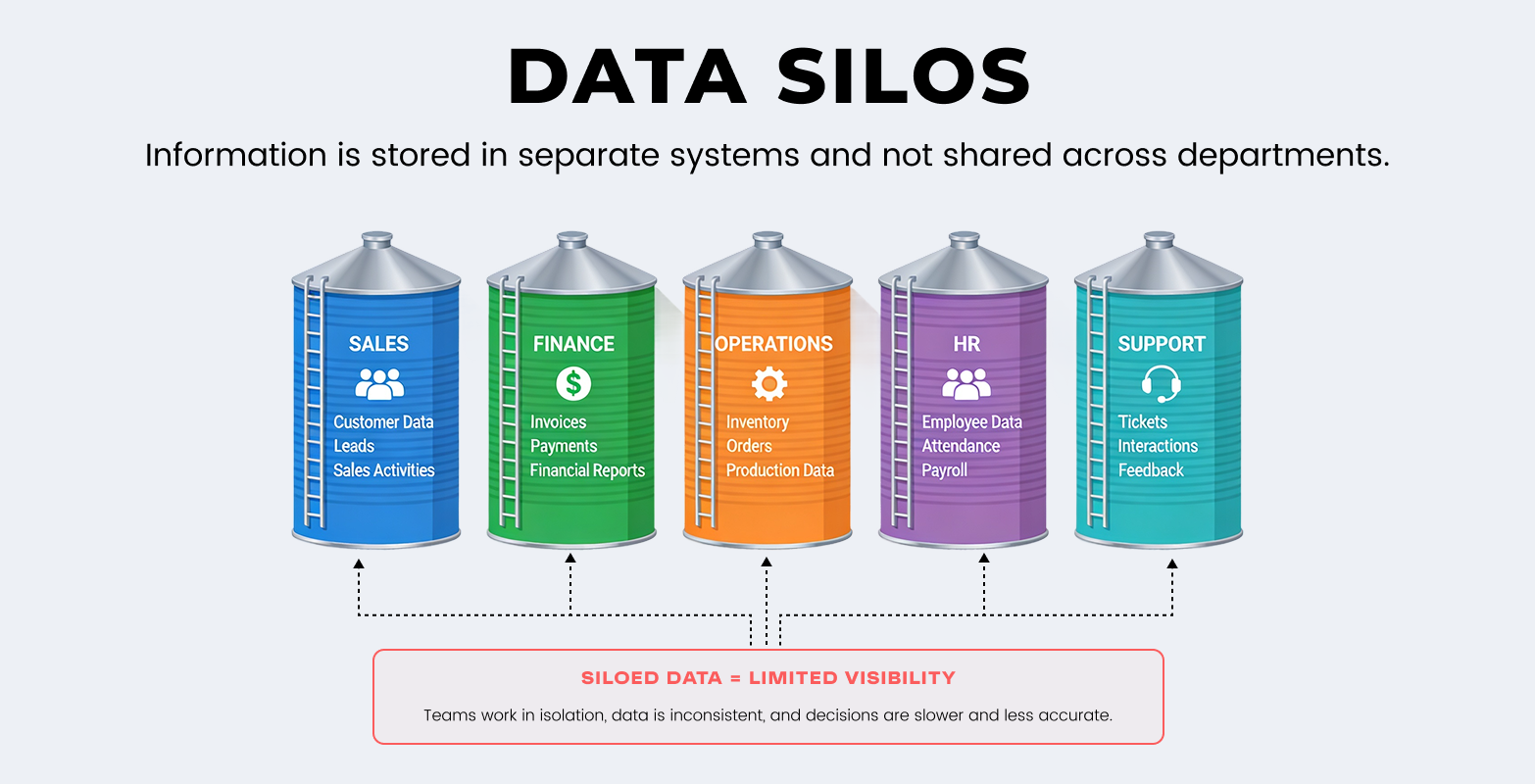
Data silos are not always the result of poor planning. They often develop naturally as organisations grow.
Different departments adopt tools that suit their immediate needs:
- sales teams use CRM platforms
- finance teams rely on accounting software
- operations teams manage spreadsheets or internal systems
- HR departments maintain separate databases
Over time, each system becomes a source of important information. The problem arises when these systems do not communicate with each other.
As a result:
- customer data may differ across departments
- financial records may not reflect real-time sales activity
- operational updates may not reach decision-makers immediately
Each department operates with its own version of information, which reduces overall alignment.
Why Data Silos Become a Problem Over Time
At a small scale, siloed data may not create immediate disruption. Teams can communicate manually, and discrepancies can be corrected when needed. However, as operations expand, the limitations become more visible.
One major issue is delayed decision-making. Managers often need to collect data from multiple sources before making decisions. This process takes time and may involve manual consolidation of reports. By the time information is compiled, it may no longer reflect current conditions.
Another issue is inconsistent data accuracy. When different departments maintain separate records, discrepancies are common. A sales team may report one set of numbers, while finance reports another. These inconsistencies reduce confidence in data and make planning more difficult.
Data silos also create communication gaps. Without shared visibility, teams may not be aware of changes happening in other departments. This can lead to duplicated work, missed updates, and operational delays.
The Impact on Business Growth
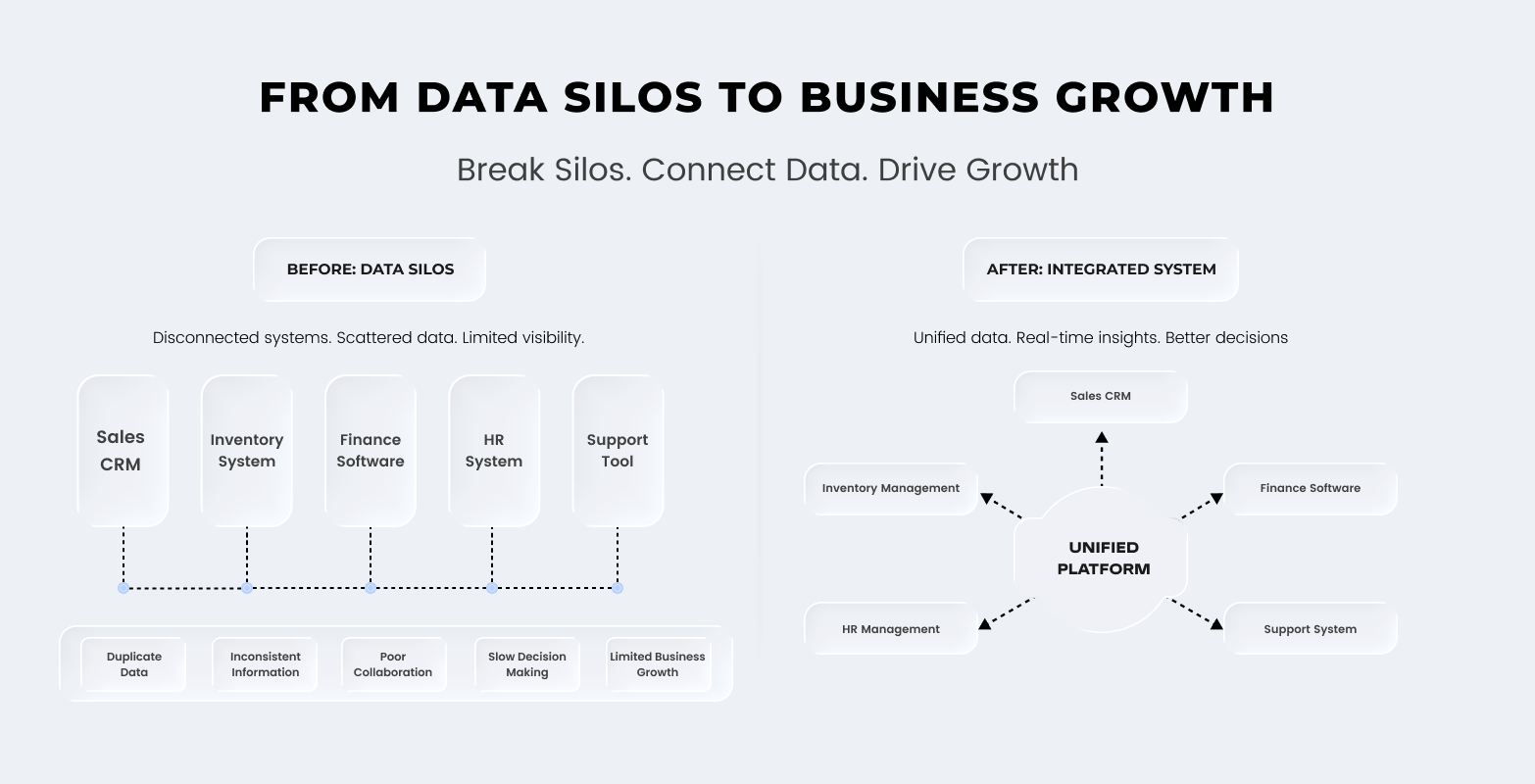
Data silos do more than slow down processes. They directly affect how businesses grow. Growth requires coordination between departments. Sales must align with operations, finance must track performance accurately and management must have a clear view of overall activity.
When data is fragmented:
- forecasting becomes unreliable
- resource allocation becomes inefficient
- customer experience becomes inconsistent
For example, if a sales team closes deals without real-time visibility into inventory or delivery timelines, operations may struggle to fulfil commitments. This creates friction that affects both internal efficiency and customer satisfaction.
Over time, these issues limit scalability. Businesses may continue to grow, but not efficiently. Over time, this lack of alignment creates compounding inefficiencies. Departments may meet their individual targets, but the organisation as a whole struggles to operate cohesively. Growth becomes uneven because processes are not synchronised. This often leads to increased operational costs, delayed delivery timelines, and reduced ability to respond to market changes. Businesses may continue to expand in size, but without integrated data, that growth lacks efficiency and control.
How Data Silos Affect Customer Experience
Customer experience is often one of the first areas impacted by siloed data. When departments operate independently, customers may receive inconsistent communication.
For example:
- support teams may not have access to sales history
- finance teams may not see customer interactions
- sales teams may not know about previous service issues
This lack of visibility creates disjointed interactions. Customers expect continuity. They expect organisations to understand their history and respond accordingly. When data is siloed, this continuity is lost.
As a result:
- response times increase
- information must be repeated
- trust may decline
In competitive markets, these small inefficiencies can influence customer retention.
Operational Inefficiencies Caused by Data Silos
Beyond customer experience, internal operations are also affected.
Teams often spend time:
- searching for information
- verifying data accuracy
- reconciling differences between systems
- manually updating records
These activities do not contribute directly to growth but consume significant time. Siloed environments also make it difficult to identify operational bottlenecks. If data is scattered, it becomes harder to see where delays occur or which processes require improvement. This reduces the organisation’s ability to optimise workflows.
In many cases, these inefficiencies are not immediately visible because they are distributed across teams. Each department may compensate for missing information through additional effort, which masks the underlying issue. However, as workload increases, these compensations become unsustainable. Employees spend more time managing data inconsistencies than contributing to strategic activities, which directly affects productivity.
Why Businesses Often Fail to Address Data Silos Early
Despite the challenges, many businesses continue operating with siloed systems for longer than expected. One reason is that the problem develops gradually. Each department optimises its own processes, and the lack of integration does not appear urgent until complexity increases.
Another reason is the assumption that integration requires major system changes. Organisations may delay action because they believe restructuring systems will disrupt operations. However, delaying integration often increases complexity over time. As more tools are added and more data accumulates, connecting systems becomes more difficult.
Moving Toward Integrated Systems
Addressing data silos begins with recognising that isolated systems cannot support long-term growth. As operations expand, businesses require environments where information flows seamlessly across departments. Integrated systems are designed to connect data sources and ensure that updates in one area are reflected across the organisation.
For example:
- sales activity updates financial records automatically
- inventory changes are visible to sales and procurement teams
- customer interactions are accessible to support teams
This level of coordination reduces the need for manual data transfer and improves consistency across operations. Integration does not always mean replacing existing systems immediately. In many cases, businesses begin by connecting key platforms so that data can move between them more efficiently.
The Role of ERP and CRM in Breaking Data Silos
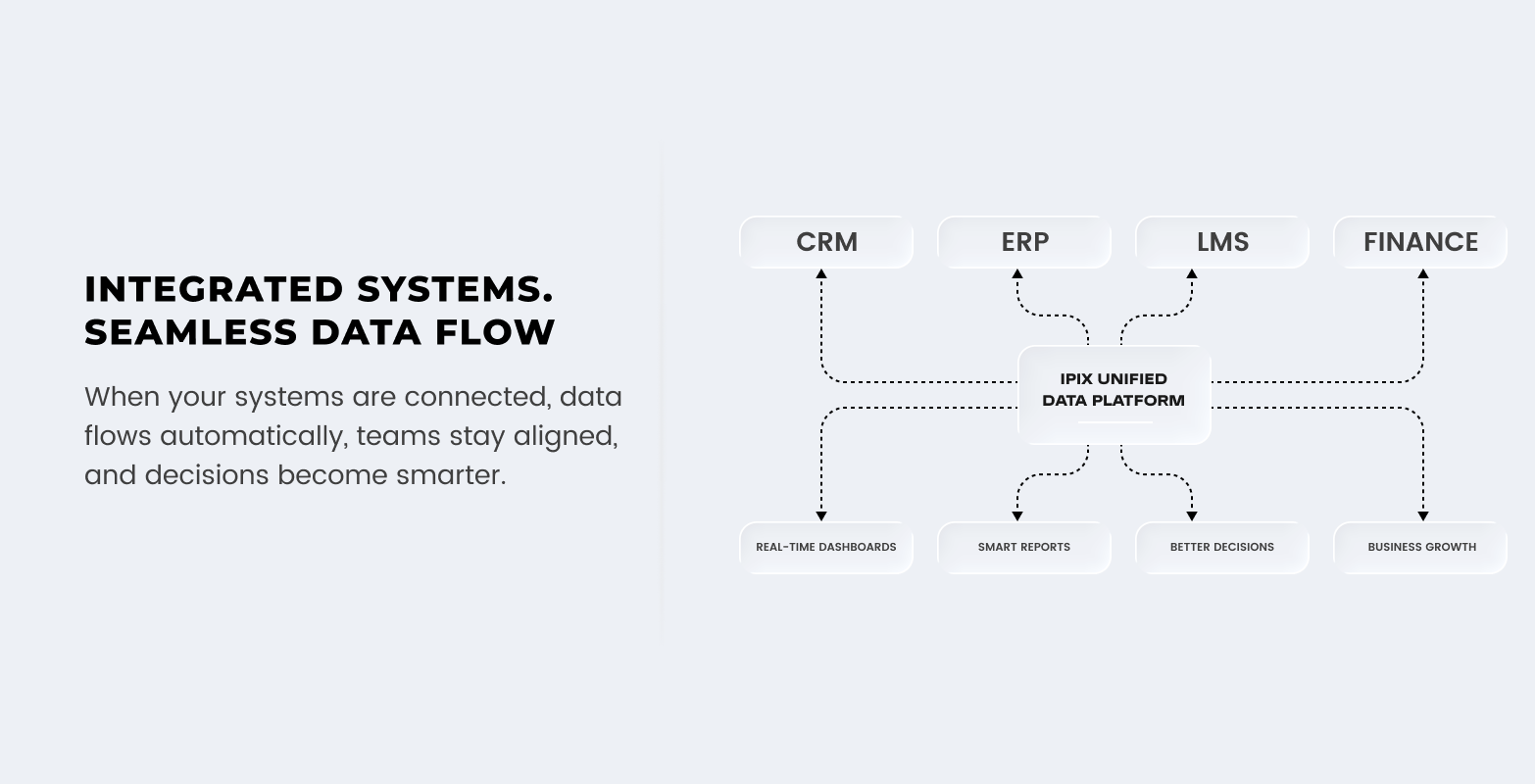
Enterprise Resource Planning and Customer Relationship Management systems play a central role in reducing data fragmentation. An ERP system integrates core business functions such as finance, procurement, inventory, and operations into a single environment, while a CRM system focuses on managing customer interactions and sales data. When implemented effectively, these systems create a shared data environment where departments no longer operate independently.
Many organisations exploring integrated systems often begin by evaluating the best ERP software in India, particularly solutions that support real-time data flow and cross-department coordination. Instead of maintaining separate records, teams can access consistent information from a centralised platform, improving both accuracy and operational alignment.
Using APIs and Integration Tools
Not all businesses can transition to fully integrated systems immediately. Existing tools, legacy systems, and operational constraints often require a gradual approach. Application Programming Interfaces (APIs) provide a way to connect different systems without replacing them entirely.
APIs allow:
- data exchange between platforms
- automated updates across systems
- synchronisation of key information
For example, a CRM system can share customer data with an accounting platform, or an inventory system can update order status within a sales dashboard. These connections reduce duplication and help maintain consistency. Integration tools also allow businesses to prioritise which systems need to be connected first, making the transition more manageable.
Improving Data Visibility Across the Organisation
One of the immediate benefits of reducing data silos is improved visibility. When systems are connected, businesses gain access to real-time information across departments.
This allows managers to:
- monitor performance indicators
- identify operational delays
- track customer activity
- evaluate resource utilisation
Better visibility leads to faster and more informed decision-making. Instead of waiting for manually prepared reports, organisations can access updated data whenever needed. This responsiveness is essential in environments where conditions change quickly.
Strengthening Collaboration Between Teams
Integrated data environments also improve collaboration. When teams work with shared information, communication becomes more efficient.
For example:
- sales teams can see inventory availability before confirming orders
- support teams can access customer purchase history
- finance teams can track transactions without additional verification
This reduces back-and-forth communication and minimises the risk of misalignment. Collaboration becomes process-driven rather than dependent on manual coordination. Over time, this creates smoother workflows and reduces internal friction.
Building a Data-Driven Organisation
Breaking data silos is not only about operational efficiency. It also supports the transition toward data-driven decision-making. When information is centralised and consistent, businesses can analyse patterns more effectively.
This includes:
- identifying trends in customer behaviour
- evaluating product performance
- monitoring operational efficiency
- improving forecasting accuracy
Data-driven organisations are better positioned to adapt to market changes because they rely on measurable insights rather than assumptions. However, this level of analysis is only possible when data is accessible and reliable.
Long-Term Benefits of Eliminating Data Silos
The impact of reducing data silos becomes more visible over time.
Businesses experience:
- improved operational efficiency
- reduced manual workload
- better decision-making accuracy
- enhanced customer experience
- stronger scalability
As organisations grow, integrated systems support expansion without introducing additional complexity. Processes become easier to manage, and teams can focus on strategic activities rather than administrative coordination.
This creates a more stable foundation for long-term growth.
Conclusion
Data silos develop gradually, but their impact becomes significant as businesses expand. When information is fragmented across departments, decision-making slows down, communication gaps increase, and operational efficiency declines.
Addressing this challenge requires a shift toward integrated systems that allow data to move freely across the organisation. Whether through ERP platforms, CRM systems, or API-based integrations, the goal is to create a unified data environment that supports coordination and visibility.
At IPIX, digital solutions are designed to help businesses move beyond disconnected systems and build integrated operational structures. As an experienced IT company in India, IPIX focuses on creating scalable systems that improve data flow, strengthen collaboration and support sustainable business growth.



































 Talk to our Expert
